

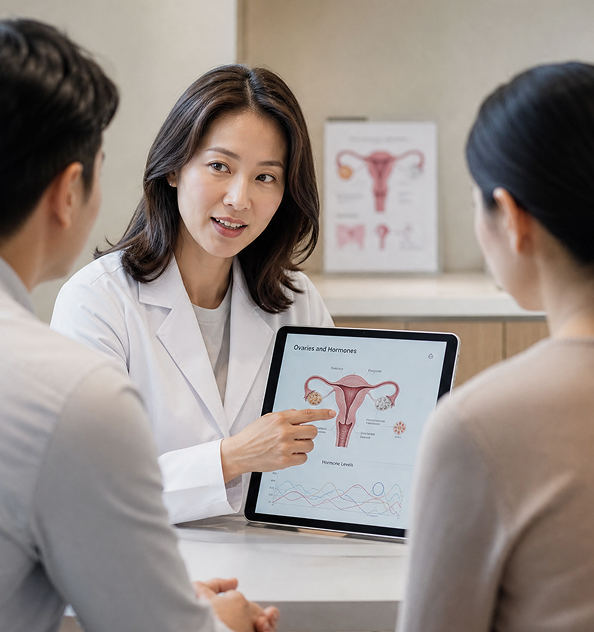
Infertility affects many couples today, and when it comes to treatment, one of the most commonly discussed steps is ovarian stimulation to retrieve mature eggs for IVF. However, even when patients undergo the same stimulation protocol, their ovarian response can vary considerably. This variability is influenced by multiple factors, including age, ovarian reserve, and hormonal status. In addition, genetic variation—particularly in the FSH receptor (FSHR) gene—has been shown to affect ovarian sensitivity to follicle-stimulating hormone (FSH), thereby contributing to individual differences in response to ovarian stimulation. Understanding the characteristics of FSHR allows physicians to create more effective personalized treatment plans, increasing the chances of pregnancy while minimizing hormone-related complications during infertility treatment.
What is FSHR?
FSHR (Follicle-Stimulating Hormone Receptor) is a protein located on the surface of specific reproductive cells, including ovarian granulosa cells. Its function is to receive signals from follicle-stimulating hormone (FSH), which is released by the pituitary gland and plays a key role in follicle growth and ovarian function.
FSHR is the “lock” on reproductive cells, and FSH is the “key.”
How well the lock responds to the key determines how effectively the ovaries function during both natural cycles and fertility treatment.
When this signaling pathway works efficiently, the ovaries tend to respond appropriately to stimulation. If the receptor is less sensitive, the ovarian response may be lower than expected.
The Role of FSHR in Egg Development
FSHR affects how sensitive the ovaries are to stimulation and influences how many follicles develop in each treatment cycle.
When FSHR sensitivity is adequate, follicles tend to grow in a more predictable and balanced way.
When sensitivity is reduced, higher medication doses may be needed, yet the ovarian response may still be limited.
It is important to note that FSHR does not determine egg quality on its own. Egg quality is influenced by multiple factors, including age, ovarian reserve, and overall health.
Individual responses to ovarian stimulation vary, and one contributing factor is genetic variation in the FSHR gene, particularly the N680S (rs6166) polymorphism. This genetic variation can affect how sensitive the FSH receptor is to hormonal stimulation.
Some genetic variants are associated with a stronger ovarian response to FSH.
Other variants may be associated with reduced sensitivity, requiring adjustments in medication type or dosage.
FSHR genetic testing can therefore serve as supportive information, alongside clinical markers such as AMH and AFC, to help physicians design a more personalized ovarian stimulation plan. This approach may reduce unnecessary hormone exposure and improve the efficiency and safety of fertility treatment.
Using FSHR genetic information in reproductive medicine is a modern approach that enhances stimulation efficiency and reduces potential complications.
Selecting the Right Stimulation Medication
Based on the N680S genetic variant, physicians can choose the optimal hormone type:
Matching hormone type with genetics leads to safer and more effective ovarian stimulation.
Reducing Risk of Over- or Under-Stimulation
Knowing whether the ovaries are highly or poorly responsive helps determine accurate dosing, lowering risks such as OHSS (Ovarian Hyperstimulation Syndrome) or inadequate egg yield.
Increasing IVF/ICSI Success Rates
When medication type and dosage align with genetics, ovarian stimulation becomes more effective, producing high-quality eggs for fertilization and boosting pregnancy and live birth rates with ICSI.
Evidence From Hjelmér et al. (2025) showed:
A study by Hjelmér et al. (2025) evaluated the impact of FSHR N680S genotype–guided ovarian stimulation compared with standard treatment strategies.
The study reported that:
Cumulative pregnancy rates were higher in the genotype-guided group (approximately 51%) compared with the standard treatment group (approximately 40%).
Cumulative live birth rates were also higher in patients receiving genotype-guided stimulation, reaching up to around 40% in certain subgroups.
In addition, treatment response patterns observed in the study suggested that:
S-allele carriers tended to show a more favorable ovarian response when treated with urinary FSH (uFSH).
NN-allele carriers tended to respond more favorably to recombinant FSH (rFSH) in terms of follicular development.
These findings suggest that FSHR genotype–guided ovarian stimulation may improve treatment efficiency and cumulative outcomes when used alongside standard clinical assessments.
FSHR testing is a genetic analysis that identifies variants affecting ovarian response to FSH. Testing is performed using a blood sample or DNA from a cheek swab. Results help physicians plan more accurate personalized treatment.
Genetic differences in the FSHR gene may cause the ovaries to respond poorly. Knowing your FSHR genotype helps physicians select the right medication and dosage, improving outcomes.
You can undergo testing and consultation at VFC Center (V-Fertility Center), which provides genetic evaluations and advanced reproductive technology tailored to each patient.
It is not required for patients with normal ovarian response. However, it is highly beneficial for poor responders, patients with failed IVF cycles, or those seeking optimized outcomes.
A: Individuals planning IVF/ICSI who want the highest success rate